
From Ratings to Fandom: How Content Value Has Shifted in the Global Marketplace
What are companies really looking for in today’s international markets? The rise of expandable IP is reshaping global content strategy, and the future of entertainment is no longer measured solely by ratings or viewing hours, but by community.
-
By Rosa Fuentes
- 13/05/2026

Behind the screenings, hotel suites, and closed-door meetings, a broader reality is shaping the global audiovisual business: a structural shift in what makes content valuable, how it gets monetized, and how it scales internationally. Increasingly, the industry’s biggest challenge is conceptual, moving beyond pure audience metrics into the territory of loyalty, fandom, and cultural impact.
For years, the business was obsessed with reach. Bigger ratings. Bigger subscriber numbers. Bigger viewing minutes. Today, the real goal is building communities that last — audiences that spark conversations both online and offline, communities that recommend, share, engage, and keep coming back.
That’s why companies are putting growing emphasis on fandom-driven IP, expandable universes, live experiences, social interaction, identity-based storytelling, and transmedia narratives. Content is no longer competing only for screen time or ratings points; it’s competing for cultural relevance.
Netflix itself has been unusually direct about this strategy in communications with shareholders: “In a world of fleeting attention and fragmented audiences, we believe large-scale event programming that attracts massive audiences delivers differentiated value for both our members and our business.” And co-CEO Ted Sarandos summed up the company’s positioning philosophy with a line that increasingly feels like the industry’s new playbook: “We don’t just make shows. We build universes.”
Just days ago, the platform released its The Netflix Effect report, highlighting the cultural footprint its productions have generated across multiple territories worldwide, where series evolve beyond episodic entertainment to become both local and global cultural events.
Netflix’s vice president of marketing offered a revealing example of the organic scale behind that strategy: for a Stranger Things fan event in Istanbul, the company expected around 2,000 attendees. More than 20,000 people showed up. The kind of overflow that has increasingly become standard for the platform’s fan-driven activations around the world.
International markets themselves are evolving as well. They are no longer just transactional spaces for buying and selling content. Today, they function as real-time barometers for the business — places where the industry tests trends, recalibrates strategy, measures audience behavior, and, above all, tries to answer one defining question: how do you retain audiences in an era where attention has become the scarcest currency in entertainment?
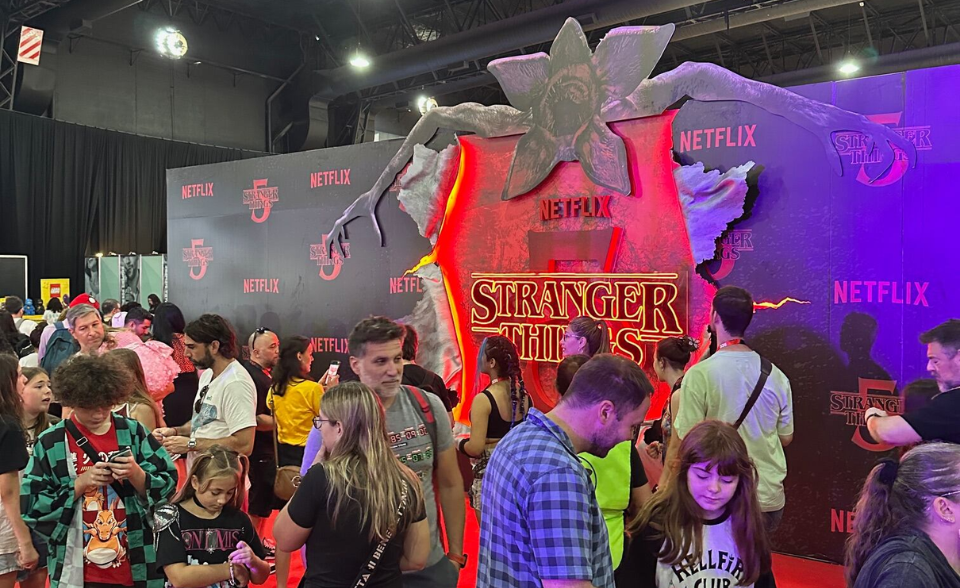
The Industry’s Latest Obsession: IP Built to Expand
One of the biggest shifts in recent years is that companies are no longer looking for just a hit series or movie. They’re looking for universes. Spin-offs, prequels, international remakes, video games, podcasts, live experiences, and merchandising are now all part of the same long-tail monetization strategy.
The phenomenon of Money Heist became a watershed moment for the industry. The Spanish drama proved that a production born as a local title could evolve into a global franchise capable of generating spin-offs, fandom, and long-term brand value for years.
According to an analysis published by FilmTake around the 2026 edition of the European Film Market, the industry conversation is increasingly centered on IP strategy, library value, and long-term monetization, at a time when content is being evaluated based on shelf life and expansion potential. The questions now driving acquisition decisions are remarkably consistent: Can it generate fandom? Does it have multiplatform potential? Can it travel across territories? Can it evolve into a franchise?

The More Local, the More Global
The rise of Korean, Turkish, Spanish, and Latin American content confirmed something platforms took years to fully understand: global audiences are not looking for cultural neutrality. They’re looking for authenticity — the kind that only deeply local storytelling can provide.
Series such as Squid Game, Elite, and Who Killed Sara? demonstrated that stories rooted in strong cultural identity can travel internationally when they create emotional connection. That helps explain why Latin America continues to gain strategic relevance in international markets: the region offers competitive production costs, well-established technical capabilities, exportable creative talent, historically global genres such as telenovelas, and culturally distinctive storytelling.
In a recent interview with ttvnews, Mariano César, Head of General Entertainment Content at Warner Bros. Discovery for Latin America and U.S. Hispanic, said the company prioritizes local authenticity above all else. While César acknowledged that “economically, it’s very convenient when content travels,” he made it clear that international scalability is not the starting point of the creative process.
According to the executive, it is precisely the productions that fully embrace their local identity that ultimately resonate regionally — and sometimes globally. “We believe the projects that succeed internationally are the ones that don’t give up their local identity, but instead wear it proudly,” he said.
International buyers are increasingly looking for content with a strong regional voice that can still plug into global storytelling dynamics: fast pacing, immediate hooks, binge-worthy structure, strong social conversation, and adaptation potential.
FAST and AVOD: Advertising Is Back at the Center of the Business
The rise of FAST and AVOD has dramatically reshaped priorities across the international market, fueled by subscription fatigue, growing economic pressure on consumers, and the urgent need for alternative monetization models. The industry is now operating in a far more hybrid environment.
That shift has revalued content categories that were historically underestimated: library content, reality shows, lifestyle programming, true crime, daily entertainment, and repeatable formats. Comfort viewing is suddenly a premium asset again. And that’s where Latin America holds a significant competitive advantage, with decades of experience producing telenovelas, entertainment formats, and long-tail content libraries — exactly the kind of programming the FAST ecosystem depends on.
Advertising monetization has moved back to the center of the industry conversation. The objective is no longer simply adding subscribers. The game now is maximizing profitable watch time.
Even Goldman Sachs, which attempted to model the economic potential of superfans, built its projected $4 billion opportunity on the assumption that these users are essentially subscribers willing to pay more. But that hypothesis arguably underestimates the fragmented and highly volatile nature of fan spending. The real fandom economy is richer — and far less predictable — than any recurring revenue model can fully capture.