
Laboratorio Impulsar: The Next Generation of Argentine Cinema Begins to Take Shape
Beyond the lab itself, Impulsar represents a sign of the times: an effort to strengthen the most fragile stage of the audiovisual value chain, the development of projects. It does so with a federal approach, a diversity of genres, and direct connections to the industry players who can turn an idea into a production.
-
By Rosa Fuentes
- 05/08/2026

The audiovisual industry’s best-known bottleneck is how to bridge the gap between a creative idea and the actual development of a production. In a challenging market environment, the Argentine Academy of Motion Picture Arts and Sciences, in partnership with the Netflix Fund for Creative Equity’s Skills and Training Program, has launched Laboratorio Impulsar, a nationwide audiovisual development program designed for a new generation of filmmakers.
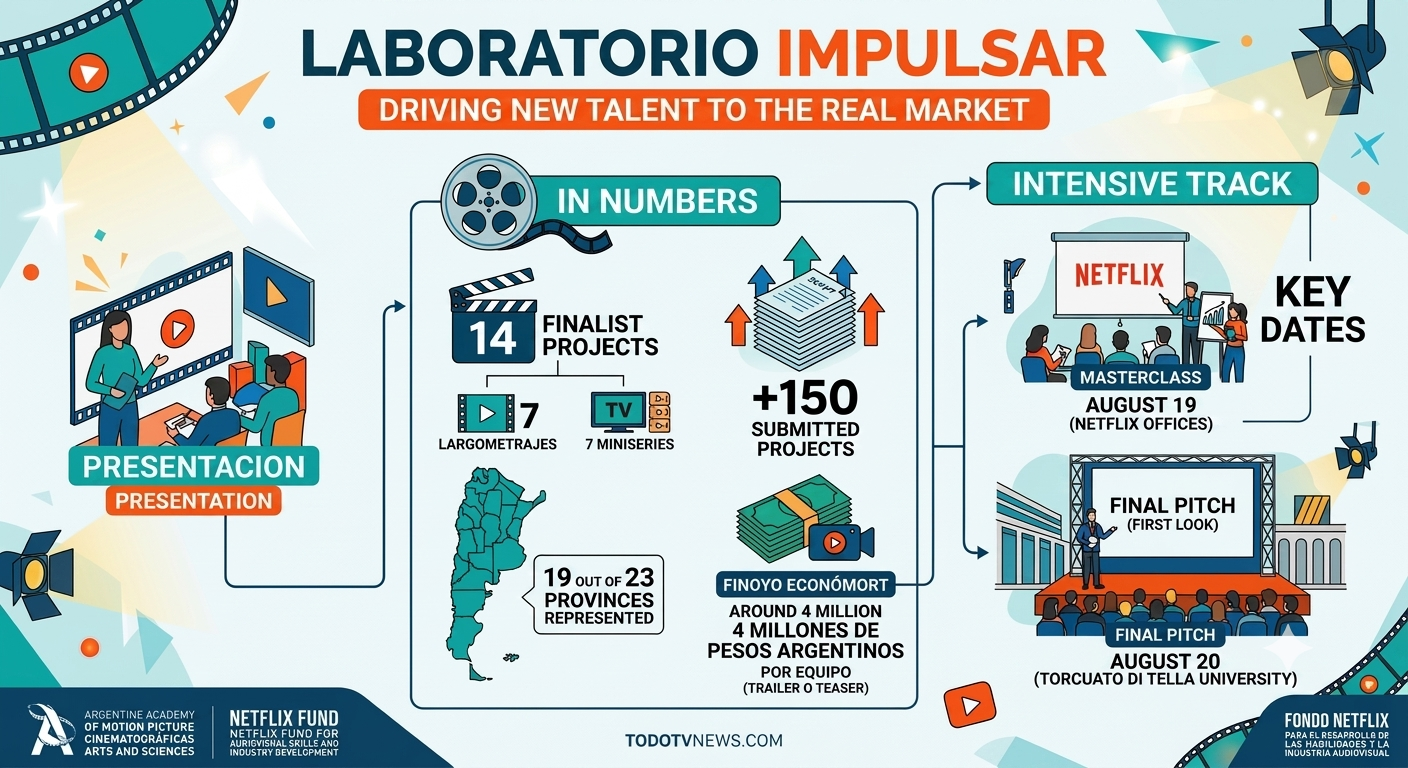
The initiative addresses one of the industry’s most persistent gaps: how to move from film school -or creative instinct- to meaningful access to the professional market. Fourteen projects from across Argentina have already been selected and are now entering a program of training, mentorship, and industry exposure, culminating in an in-person pitching event with leading executives and decision-makers.
The open call was developed in collaboration with universities and cultural institutions throughout the country to ensure participation extended beyond Buenos Aires, as is often the case with similar initiatives. The response exceeded expectations: more than 150 projects were submitted from across Argentina, confirming that the demand was there, it simply lacked a platform. From those submissions, 14 finalists were selected: seven feature films and seven miniseries.
Sabrina Farji, Pablo Ingercher, and Martín Desalvo, members of the Argentine Academy’s board, discussed the initiative in an interview with ttvnews.
As Martín Desalvo, board auditor of the Argentine Academy of Motion Picture Arts and Sciences, explains: “There was an enormous demand, above all, for guidance on how to truly break into the industry.”
What Stories Is Argentina's New Generation of Filmmakers Telling?
Beyond the logistics, the selection process revealed a compelling generational trend—one that is likely to resonate with both content analysts and acquisition executives. Pablo Ingercher, Secretary of the Academy, identified a recurring theme across many of the selected projects: inherited burdens, fractured families, and personal or social structures perceived as exhausted.
“The recurring question seems to be less ‘Who do I want to be?’ and more ‘What do I do with what I’ve inherited without ever choosing it?'” he explained.
At the same time, the slate was intentionally curated to showcase a broad range of genres. The selected projects include senior-focused comedies, romance, queer narratives, fantasy, political thrillers, horror, children’s animation, and sports dramas—a diverse pipeline that could prove attractive to broadcasters and streaming platforms looking for original acquisition opportunities.
From Mentorship to a Professional Pitch Deck
The program combines personalized online training—with active industry professionals mentoring participants in directing, producing, screenwriting, cinematography, production design, sound, and editing—with a high-profile in-person showcase. Overall supervision is led by Diego Ventura (Kapow) and Silvana D’Angelo (Glowstar Media).
Each team received approximately ARS 4 million (around US$3,000) in funding to produce a trailer or teaser for their project, a decision aimed at elevating the quality of their sales materials from the outset.
“It takes participants a step further in terms of professionalization, allowing them to present themselves to the industry with a proper pitch, a pitch deck, a strong dossier, and a well-developed project package,” said Desalvo.
Building a Bridge to the Industry: A First-Look Pitch Event
The laboratory will conclude with two key events: a masterclass at Netflix’s offices on August 19, followed by a first-look pitching session on August 20 at the Universidad Torcuato Di Tella. Airfare and accommodation will be provided for all 14 teams traveling from across Argentina.
Confirmed industry participants include Pablo Culell (Underground), Vanessa Ragone (Haddock), Diego Ventura and Agustín Sacanell (Kapow), Karina Castellano and Helen Roca (Nativa), as well as representatives from provincial film organizations and the Netflix Fund.
Sabrina Farji, First Vice President of the Academy, emphasized that Impulsar is not intended to channel projects exclusively toward Netflix. Instead, it is designed as a launchpad connecting emerging filmmakers with festivals, streaming platforms, production companies, and the broader audiovisual industry.
Cinema, Industry, Culture, and Community
What sets Impulsar apart from a conventional development program is its commitment to constant evolution. Sabrina Farji revealed that a potential second edition would rethink both its target participants and its methodology based on the industry’s changing needs.
“The idea isn’t to repeat ourselves. On the contrary, every year we want to pursue a different objective that responds to what the industry needs at that moment,” she said.
Along the same lines, Pablo Ingercher framed the initiative around the Academy’s institutional motto: “We are cinema, industry, culture, and community.” He emphasized that the program is also designed to foster intergenerational exchange by bringing together filmmakers under 35 with experienced professionals from the Academy.
“It was remarkable to see the mutual appreciation and the growth that happened on both sides,” he noted.
Beyond the laboratory itself, Impulsar reflects a broader shift in the industry. It represents an effort by the Argentine Academy of Motion Picture Arts and Sciences and the Netflix Fund for Creative Equity’s Skills and Training Program to strengthen the most vulnerable stage of the audiovisual value chain—project development—while embracing a nationwide perspective, a diverse slate of genres, and direct connections with the industry players capable of turning promising ideas into productions.

Context: Impulsar and Netflix's Broader Regional Strategy
Impulsar is far from a standalone initiative. It comes as Netflix marks 15 years in Latin America while simultaneously expanding both its physical footprint and its long-term investment strategy across the region.
In April 2026, the company inaugurated its new offices in Buenos Aires’ Villa Crespo neighborhood under the banner “Made in Argentina,” while unveiling an ambitious slate of local productions for 2026–2027, including a series inspired by Moria Casán and an animated miniseries of Mafalda directed by Juan José Campanella.
At the regional level, Netflix has also strengthened its institutional partnerships. The company recently signed an agreement with CAF – Development Bank of Latin America and the Caribbean to support the audiovisual sector through talent development and inclusion initiatives. It has also maintained a longstanding collaboration with the Inter-American Development Bank (IDB), whose 21st Century Skills Coalition was launched after estimates showed that Latin America’s audiovisual industry generated approximately US$5.7 billion in production spending in 2019, supporting more than 1.6 million direct and indirect jobs across the region.
Against that backdrop, Impulsar illustrates Netflix’s broader strategy: investing not only in content production, but also in the talent pipeline and creative ecosystem that will shape the next generation of Latin American storytelling.
Industry Takeaways
For international development and acquisitions executives, Impulsar serves as an early indicator of what’s coming next. It offers a curated first look at projects that, within the next 12 to 24 months, could emerge at markets such as Ventana Sur, LA Screenings, or NEM Dubrovnik—by then backed by producers, professional trailers, and fully developed pitch materials.
The selection of seven miniseries alongside seven feature films also reflects a broader industry trend: for streaming platforms, lower-budget episodic formats continue to represent a more accessible entry point for discovering and nurturing emerging creative talent than traditional feature filmmaking.
The program’s nationwide scope is equally significant from a market perspective. For distributors, producers, and international studios already active in Latin America, it signals that Argentina’s creative center of gravity is increasingly extending beyond Buenos Aires, opening new opportunities linked to regional production incentives, competitive production costs, and more geographically diverse talent and casting strategies.