
Brazil’s Audiovisual Industry Vision: A Korean Model for Latin America?
Nova Indústria Brasil is redefining the country's industrial policy through 2033 under a framework centered on sustainability and innovation, placing audiovisual production among its strategic sectors.
-
By Rosa Fuentes
- 17/06/2026

With an eye on large-scale content exports and the development of a strong cultural industry, Brazil is reshaping its approach and seeking to become a global exporter of original content created by local talent. The move raises an important question: could the country be laying the groundwork to replicate the Korean model in Latin America?
The debate that permeated the main panels at Rio2C 2026 was not focused on tax incentives or rebates designed to attract foreign studios. Instead, it revolved around a far more ambitious goal: transforming the audiovisual sector into a strategic component of the national economy, capable of generating exports, skilled jobs, and homegrown intellectual property.
“We are building a vision for the future of Brazilian audiovisual, focused on economic sustainability, content circulation, audience development, and strengthening regional capabilities,” said Joelma Gonzaga, Secretary of Audiovisual Affairs at Brazil’s Ministry of Culture, during one of the event’s flagship panels.
Her remarks were not made in isolation. During the same discussions, Brazilian government representatives defended the integration of the audiovisual sector into Nova Indústria Brasil, the federal industrial development policy designed to strengthen sectors considered strategic to the country’s economy. The central question is no longer how to support audiovisual production as a cultural expression, but rather how to transform it into a driver of economic development over the next decade.
Minister of Culture Margareth Menezes was even more direct. “Culture is industry, it is a market, it generates jobs,” she said while advocating for the role of the creative economy within Brazil’s national strategy. Meanwhile, Márcio Elias Rosa, Minister of Development, Industry, Trade and Services, provided the economic context: the audiovisual sector already accounts for 0.6% of Brazil’s GDP and generates more jobs than several traditional industrial sectors.
Taken together, these statements reveal something unusual in the region: a government that is beginning to speak about audiovisual production using the same language it employs when discussing advanced manufacturing or biotechnology.
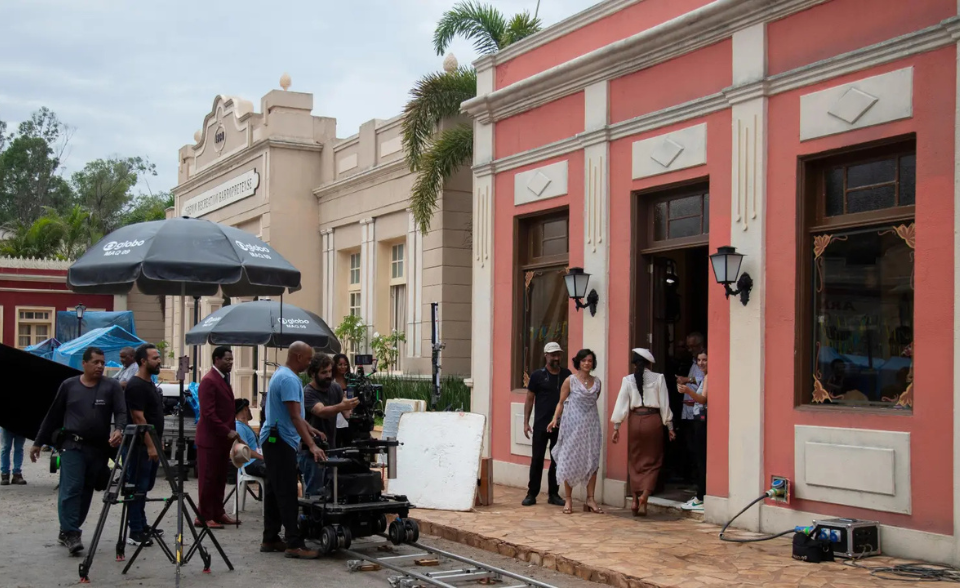
The Global Entertainment Market
The discussion about the future of the audiovisual industry is taking place amid a profound transformation of the global media and entertainment business.
According to PwC’s Global Entertainment & Media Outlook, the worldwide entertainment and media market is expected to reach US$3.5 trillion in revenue by 2029. However, growth is projected to be significantly slower than during the streaming boom of the past decade, as the industry faces intensified competition for audience attention and a slowdown in consumer spending.
In this environment, the report identifies where value will be created in the years ahead. Beyond subscriptions, growth will increasingly be driven by advertising, digital ecosystems, artificial intelligence and, most importantly, intellectual property assets capable of generating recurring revenues across multiple windows and markets.
The result is a fundamental shift in the industry’s competitive dynamics. Producing more content no longer necessarily translates into creating more value. What matters now is the ability to develop franchises, formats, brands and stories with the potential for global expansion and long-term monetization.
The Reference Point That Cannot Be Ignored

Whenever cultural industries are discussed as an economic growth engine, one case study inevitably emerges: South Korea.
The global expansion of the so-called Hallyu, or “Korean Wave,” is often associated with recent phenomena such as BTS, Parasite and Squid Game. Yet behind those successes lies a much deeper and more deliberate strategy.
Beginning in the 1990s, South Korea implemented public policies aimed at positioning cultural industries as a strategic sector of the national economy. Content production ceased to be viewed solely as an artistic activity and became a tool for economic development, exports and international influence.
Three decades later, the country exports music, television series, films, formats, video games and cultural brands that generate billions of dollars while creating positive spillover effects for sectors as diverse as tourism, technology and international trade.
It would still be premature to claim that Brazil is seeking to replicate the Korean model in a literal sense. However, the announcements and discussions that shaped Rio2C 2026 suggest a similar direction of travel. Rather than focusing exclusively on attracting international productions, the country is beginning to ask how it can systematically generate its own intellectual property, scale it globally and transform it into a strategic economic asset.
The distinction is significant. For years, the success of Latin American audiovisual markets was measured by their ability to attract foreign investment. The conversation Brazil appears to be opening now is more ambitious: how to create the conditions for the next generation of global franchises, formats and cultural brands to emerge from the region itself.
The Local Content Paradox
PwC has documented a growing global preference for local content, while the market share of major U.S. studios at the international box office continues to decline compared to pre-pandemic levels.
It is empirical confirmation of something the industry has long sensed but is still struggling to fully absorb: the globalization of distribution has not led to cultural homogenization. On the contrary, authenticity and hyper-local storytelling are becoming increasingly valuable.
Francisco Ramos, Netflix’s Vice President of Content for Latin America, has articulated this idea clearly in various industry forums: “The stories that are most culturally specific are often the ones that achieve the most universal connection.” The more global the distribution platform becomes, the more valuable authenticity of origin is.
Spain offers a compelling example of this dynamic. The Spanish government considers the audiovisual sector a strategic industry due to its global reach, its capacity to generate employment and its modernization potential through digitalization. Today, Spain ranks as the sixth-largest producer of audiovisual titles in the European Union, behind only Germany, France, the United Kingdom, the Netherlands and Italy.
Meanwhile, an analysis by Digital i found that viewing time dedicated to U.S. content across 19 international markets declined from 52% to 45% over a five-year period on major streaming platforms. Nearly all of that viewing time was absorbed by local and international productions.
The Question Brazil Is Asking the Region
This is why the discussion that emerged at Rio2C 2026 extends far beyond the Brazilian market. For years, Latin America competed to attract investment from Netflix, Disney, Warner Bros. Discovery and other major international players. It was a legitimate race, and in many markets it helped generate jobs, industry infrastructure and valuable technical expertise.
But the question now emerging is fundamentally different: can Latin America build an industrial strategy based on the export of its own content, creativity and intellectual property?
The answer will depend on access to financing, talent development, regulatory stability and international market reach. But it will also depend on something far more difficult to legislate: the ability to recognize that content is no longer merely a cultural expression. It is a long-term economic asset.
In an industry where growth is slowing, competition is intensifying and artificial intelligence is rewriting the rules of production, countries capable of building ecosystems that consistently generate intellectual property will possess a far more sustainable advantage than any tax incentive or cash rebate program.
Perhaps that is the real bet taking shape today. Not how to attract the next international production. But how to create the conditions for the next global franchise to be born here.