
Cheap, Vertical, and Viral: the Cinderella of Streaming and Its Millions of Views
Episodes run 90 seconds, shot vertical, built for the endless scroll. Microdramas are, right now, the industry’s most profitable experiment—pulling in $11 billion globally in 2025 and on track to hit $14 billion in 2026.
-
By Rosa Fuentes
- 18/03/2026

When TelevisaUnivision said two years ago it would start putting real weight behind vertical content on ViX, plenty of people shrugged it off. Felt like a low-stakes play. Just another format imported from Asia that might pop on TikTok for a hot minute and then fade.
Fast forward to Q1 2026, and that take didn’t age well. One single ViX MicrO title clocked 42 million views within weeks—numbers that, according to industry analysts, traditional broadcast series just can’t touch in the same timeframe.
Across Ibero-America, what looked like a niche experiment three months ago has turned into a full-on corporate race. From TVN Chile to Globo in Brazil, from Atresmedia to RTVE—everyone wants a piece of the scroll. Microdramas aren’t the underdog anymore.
The math that explains everything
According to Omdia, microdramas generated $11B globally in 2025 and are headed toward $14B by the end of this year. About $3B of that is coming from outside China—enough to double the combined revenue of all FAST channels worldwide.
So why are execs who used to side-eye the format now throwing budget at it? Simple: production economics.
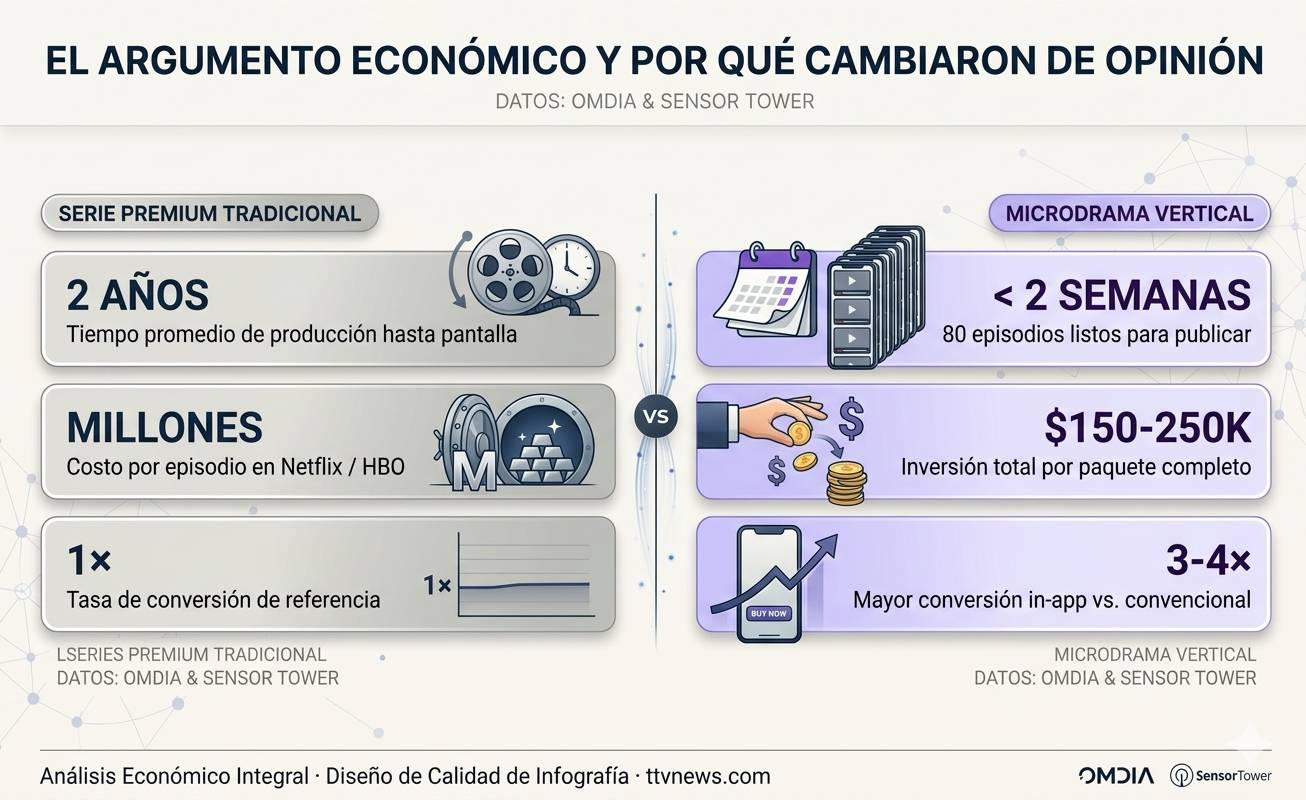
A premium Netflix or HBO series can take two years to hit screens, with massive per-episode costs. Meanwhile, an 80-episode microdrama package can be shot in under two weeks for somewhere between $150K and $250K total, based on figures floating around MIP London.
And monetization? Even crazier. In-app purchases tied to these formats are converting at 3–4x the rate of traditional content. Omdia says ARPU can hit $20 a week—or up to $80 a month.
Mobile usage data from Sensor Tower backs it up. In Q4 2025, ReelShort users in the U.S. averaged 35.7 minutes per day. Compare that to Netflix (24.8), Prime Video (26.9), and Disney+ (23.0). On mobile, at least, there’s a new attention king.
The risk everyone’s now taking seriously
Yeah, cannibalization is real. But the conversation has shifted. It’s no longer will microdramas survive?—it’s how do the big players adapt?
Answers started rolling in this quarter from some surprising places. Disney+ used CES 2026 to announce a major UI pivot: a vertical feed is coming before year’s end, designed to serve bite-sized content and microdramas daily.
Netflix is poking around the format too. Meanwhile, Shahid (MBC Group) and Russia’s Ivi are already developing their own vertical content pipelines.
New industry or just another bubble?
That’s the big question echoing through markets from MIP London to MIPCOM Cannes. Not whether microdramas will grow—but what they’ll become when they mature.
Omdia projects the sector will blow past $20B globally by 2030. But beyond the numbers, this is about a structural reset in how the audiovisual business works.
GECA’s OTT Barometer puts it bluntly: winning in streaming isn’t just about volume anymore. It’s about reading the room—anticipating how audiences want to consume content, across formats, in a hyper-competitive attention economy.

ViX MicrO leads the charge in Mexico and U.S. Hispanic
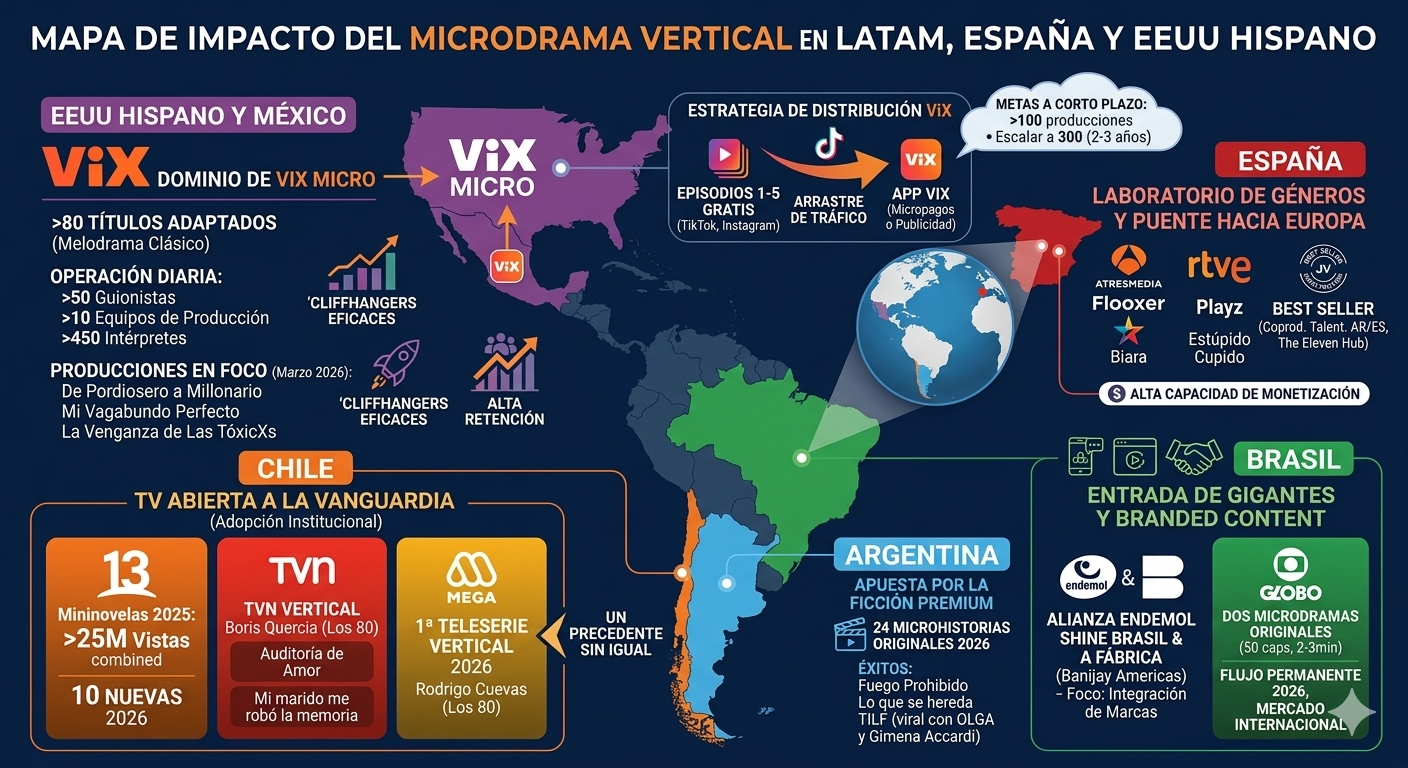
Right now, TelevisaUnivision is way out front in the region. ViX MicrO has already rolled out over 80 titles, leaning hard into classic Latin melodrama DNA—big emotions, wild twists, aspirational romance, and cliffhangers engineered to keep you tapping “next.”
Behind the scenes, it’s basically an assembly line: 50+ writers dedicated to the format, 10+ production teams running simultaneously, and a rotating cast of over 450 actors.
As of March 2026, three titles are driving buzz: De Pordiosero a Millonario, a rags-to-riches story pulling serious views since its March 5 drop; Mi Vagabundo Perfecto, a romance that’s converting especially well with Hispanic audiences; and La Venganza de Las TóxicXs, a thriller that’s killing it in retention.
The distribution strategy is key: first five episodes drop free on TikTok and Instagram to hook viewers, then push them into the app where monetization kicks in via micropayments or ads.
The goal? Hit 100 microdramas fast—and scale to 300 within a few years, all while owning the IP for spin-offs, sequels, or even traditional series adaptations.
Argentina bets on premium storytelling
While ViX is playing the volume game, Argentina is going the opposite way: cinematic quality in a vertical format.
The main player here is The Eleven Hub, part of SDO Entertainment, led by Loli Miraglia. They’ve locked in 24 original microstories for 2026.
Three are already gaining traction: Fuego Prohibido (family secrets and old flames), Lo que se hereda (a dramedy about inheritance wars), and TILF, the breakout hit distributed with OLGA and starring Gimena Accardi.
Broadcast TV goes all-in in Chile
Chile, meanwhile, is shaping up as the fastest-moving market in the Southern Cone when it comes to institutional adoption. What really sets it apart? It wasn’t indie producers leading the charge—it was broadcast networks, historically the most conservative players in the game.
Canal 13 got there first, rolling out its first two vertical “mini-soaps” in 2025—Mi boda es una trampa and El obrero que me enamoró—which together racked up more than 25 million views. Now they’re doubling down, with ten new productions slated between March and December 2026. According to digital head Cristián Hernández, the plan is simple: lock in one mininovela per month, mixing genres, casts, and locations across all platforms, including 13Go.
TVN, Chile’s public broadcaster, has also rebooted its original fiction strategy with TVN Vertical, its new microdrama hub. Actor Boris Quercia—best known for the iconic series Los 80—is directing the first project. The network is pushing ahead in 2026 with titles like Auditoría de Amor and Mi marido me robó la memoria, spanning everything from rom-com to thriller, while also building partnerships with emerging talent and brands.
Then there’s Mega, jumping in this year with its first vertical telenovela designed for Instagram and TikTok, led by writer Rodrigo Cuevas (Los 80, Si yo fuera rico). In just a few weeks, all three major networks in the country locked in their bets on the format—a move that’s basically unprecedented in Chile’s recent TV history.
Spain: genre lab and gateway to Europe
Madrid is carving out a role as a full-on genre lab. According to GECA’s OTT Barometer (Feb 2026), Spain is experimenting across the board—thriller, horror, YA—with two major players driving the space and monetization levels that outpace the rest of the region.
Atresmedia, through Flooxer, produced Biara, recently nominated for Best Digital Content at the 2026 Rose d’Or Latinos. Meanwhile, The Eleven Hub is active out of Madrid with Best Seller, a co-pro with Argentine talent set in the publishing world. RTVE has also stepped into the game with Estúpido Cupido, a vertical series dropping in 2026 on RTVE Play under its youth label Playz.
Brazil: big players and branded storytelling
Brazil is where the biggest corporate moves are happening right now. The partnership between Endemol Shine Brasil and A Fábrica (part of Banijay Americas) is charting a different path: it’s not just about scale—it’s about weaving brands directly into the storytelling.
Globo, for its part, has already launched two original microdramas (50 episodes each, running two to three minutes) and plans to keep a steady pipeline coming throughout 2026. The goal is also to take these titles global, boosting the international reach of Brazilian telenovelas.
A format moving as fast as the scroll
At this point, the industry isn’t just competing on story—it’s competing on the hook that stops your thumb in the first three seconds.
A year ago, microdramas barely registered in Western markets. Now, 2026 is shaping up as the year everything goes vertical, with Latin telenovela DNA fueling a global expansion that doesn’t care about screens or borders.
Players like ReelShort and DramaBox—Chinese platforms now licensing Latin content—and companies like Fumero Films, pushing into Europe, are helping round out an ecosystem that already looks like a fully formed industry.
Clear hierarchies. Real money. Bigger bets. And the first real fights over quality.
Latin American telenovelas took decades to conquer the world.
Their vertical successor? It’s doing it in months.