


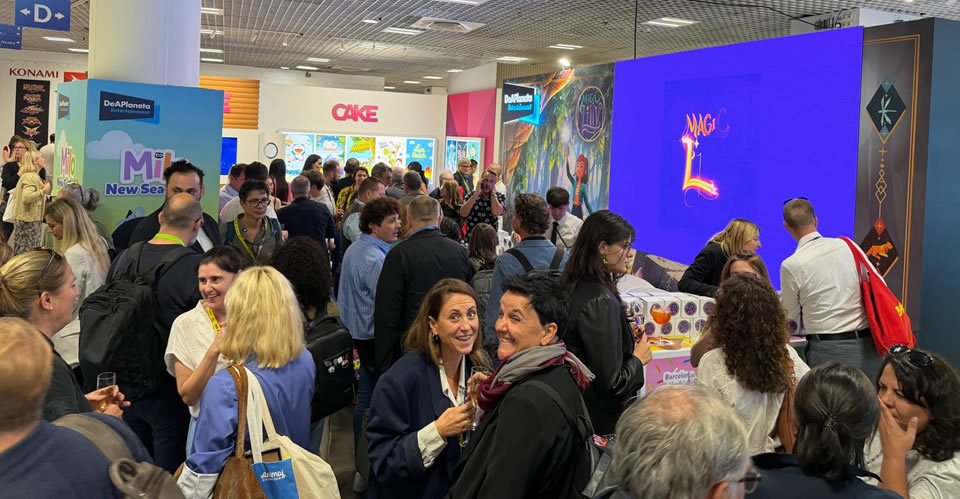
The Spanish company officially unveiled Magic Lilly at a Mipcom cocktail reception, where it also showcased the first images from Milo’s third season. Speaking with ttv, Carlos Biern revealed that a second season and feature film for Magic Lilly are already in development and discussed the expansion of DeAPlaneta’s key brands.
*with reporting by Carolina Mussio and Ana Paula Carreira from Cannes, France.
DeAPlaneta Entertainment hosted a cocktail reception at its Mipcom 2026 stand on Monday, October 12, to officially introduce Magic Lilly, its new CGI animated series based on the well-known German publishing franchise Hexe Lilli. The event brought together international partners and industry professionals involved in the development and commercialization of the production.
“Yesterday, we presented for the first time what I believe is DeAPlaneta’s most anticipated property in recent years. It’s a globally recognized brand that has had a huge following since it began as a book series. It’s Magic Lilly, originally known as Lilly the Witch,” Carlos Biern, Content & Media Sales Director at DeAPlaneta Kids & Family, told ttv at the market.
“We’ve been working on this project for more than a year with major European broadcasters, who fell in love with the brand as soon as they saw the concept and became part of the project. We’ve also worked on the scripts with top American writers who have been involved in major franchises from Disney, Lucasfilm, Marvel and Paramount,” he added.
The new series will comprise 26 episodes of 22 minutes and follows Lilly, a young girl who must balance school life with the adventures and responsibilities of mastering her magical powers. Based on Knister’s books, the project involves RTVE, TV3, Rai and Super RTL.
“We’re extremely happy with the reception. We believe this is a brand that originated in Europe, will be produced in Europe and has been developed through international collaboration. More than a series, we’re creating a new franchise that can go very far. We’re already working on a second season and a feature film,” Biern revealed.
The new adaptation retains the franchise’s fantasy elements while updating its lead character to connect with a slightly older audience. “It’s a series with brilliant writing, plenty of humor and a strong emotional component. I think it has what animation series need today. Children as young as eight or nine are already starting to watch a lot of live-action fiction on streaming platforms, and we needed a series with a more mature character,” he explained.
“In the books, Lilly was a little girl traveling around the world with a dragon. Now we have a preteen dealing with everyday problems: social media, school, family, siblings and romance. She’s growing up and learning how to become an adult at the same time as she’s discovering how to use her magical powers,” he said.
“Who wouldn’t want to become invisible, stop time or speed it up? Or transform things into other objects? We’ve taken all those powers we would have loved to have as teenagers and put them into very funny situations. I think it’s an important evolution for the brand,” he added.
Biern also highlighted the initial response from buyers and the property’s potential beyond television.
“The market’s reaction, just from the first clips we’ve shown, has been impressive. I believe we’ll bring in new partners. We’re also working extensively on licensing to build a brand with a much broader life. We were involved from the beginning with a franchise as well known as Miraculous: Ladybug, and we believe Magic Lilly can eventually take up that mantle,” he said.
Milo Prepares Season Three and Expands Its World
Another highlight of DeAPlaneta’s Cannes presentation was the first footage from the third season of Milo, its preschool series coproduced with Fourth Wall. The new season, currently in production, will comprise 52 episodes of 11 minutes.
“We also presented the first images from Milo season three. Preschool projects require an enormous amount of development and time because there’s so much competition worldwide. Most broadcasters and platforms have their own preschool content, so getting a brand to work globally is really difficult,” Biern said.
Originally inspired by a British book, the franchise has received awards in the UK and secured international broadcaster agreements, including PBS in the United States.
“From the very beginning, we won awards in the UK. We won Best Preschool Series and were later nominated for Best International Series. It’s a coproduction with Milkshake!, and we’ve managed to bring it to broadcasters around the world, including PBS in the US, which is one of the hardest goals to achieve because of how carefully they select and develop their content,” he said.
“The series has been sold around the world and continues to be renewed. What’s most interesting is that in the third season we’ve introduced new characters, more dynamic storytelling, songs and plenty of music. And above all, we’re introducing Twilo, Milo’s little sister. She’s adorable, innocent and incredibly cute, and people are already falling in love with her,” he explained.
The expansion of Milo also includes apps, video games, music, audiobooks and new developments connected to Milotown, the setting for the characters’ adventures.
“We want the brand to grow dynamically and consistently, with all the digital content we needed to develop. We have apps, video games, lots of music and audiobooks, as well as activities that let parents and children spend time reading stories together,” Biern said.
“The theme of professions is something everyone can relate to. It’s no longer just about becoming a doctor, an astronaut, a footballer or an actor. There are jobs children might never even imagine, like creating video games, programming a television channel or becoming a meteorologist. We’re introducing many different professions connected to what children experience at school and at home,” he added.
He also discussed the evolution of the show’s storytelling and the expansion of its universe.
“We’re doing a lot of work with Milotown, bringing the main characters closer to that world. We’re delighted with the response to the way the property is evolving. We want Milo to be a global preschool brand, but also a global digital brand,” he said.
During Mipcom, DeAPlaneta Entertainment also announced a partnership with Tiger Studio to relaunch Pucca internationally as the South Korean franchise marks its 20th anniversary.
The agreement introduces a new content and experiences strategy for the property. DeAPlaneta will handle international audiovisual and social media rights, excluding Asia, as well as consumer products rights across Europe, the Middle East and Africa (EMEA).
The collaboration will explore new opportunities across content, digital platforms, licensing and gaming, with additional initiatives expected to be announced in the coming months.
The Potential of Latin American Animation
Biern also discussed the region’s creative talent and the challenges facing children’s content production in Latin America.
“Latin America has a very interesting community when it comes to digital content and social media. We’ve regularly worked with partners in Mexico, Brazil and Chile. There are great designers and artists, and we’re identifying studios that provide services to companies such as Netflix, Amazon, Disney and Paramount,” he explained.
“It’s also very important to have spaces such as the Quirino Awards in Tenerife, where creators can come together, get to know one another and begin developing brands. Many of those brands start in the digital ecosystem, on YouTube, and I think there’s enormous potential there,” he added.
However, he said funding challenges and changing viewing habits continue to affect the development of new intellectual properties.
“Since we lost outlets such as Discovery, the landscape has become more complicated. Disney+ has tried to fill some of that space, and Warner is making efforts too, but unfortunately YouTube is now the main channel for many children’s audiences in Latin America. That’s positive in terms of fans and engagement, because it’s also free, but it’s very difficult to make a brand easily identifiable within YouTube’s algorithm,” he said.
“Public broadcasters are investing less and less, and we’re losing programming opportunities where we could develop bigger projects. At the same time, there are brands emerging in Argentina and Mexico with global potential. We don’t need to explain what El Reino Infantil has achieved,” he added.
The executive believes emerging digital environments can support the development of intellectual properties capable of reaching international markets.
“We have a very interesting community of creators, designers and directors. There are examples like Guillermo del Toro and Jorge Gutiérrez, who have shown what Mexican talent can achieve. I hope we continue to see new brands and new intellectual properties achieve major international success, even if they’re born on YouTube or through video games. I think those are very interesting opportunities,” Biern concluded.