
The co-owner and producer at Glassriver shares his experience working on successful international co-productions, alongside his strong belief that Iceland is uniquely positioned to play a huge role as a European partner for all kinds of projects.
A small country, yes, but more than capable of leaving a big footprint in the audiovisual industry, Iceland “has a lot to give”, as Andri Ómarsson, co-owner and producer at Glassriver, likes to point out.
Many of Iceland’s stronger elements are well-known in the industry, with titles like Game of Thrones, True Detective or Interstellar making use of some of its premier locations, but Ómarsson is certain that there is more to potential to explore.
“In Iceland we have the studio facilities, the equipment, and an exceptionally good crew, that are not being capitalized on currently”, explains the executive. “We have always been a frontrunner as a location and an international parent, and we still have a lot to give”.
How does a title like Cold Haven, a co-production between Glassriver and SPi (Portugal), showcases the beauty and possibilities that Iceland offers as a location?
The landscape, the environment and the nature overall, are a constant thing for us here in Iceland. We have eruptions, earthquakes, crazy winters and crazy summers. That’s a constant factor in our life and we try to integrate this into our stories: it plays a role in most of the work we do.
Cold Haven is a great example of that. We have a woman and her daughter fleeing an abusive relationship. They go to this place [Editor’s note: archipelago of Vestmannaeyjar] that in the beginning looks extraordinarily beautiful, picturesque. This is my birth town, so I hold it dear; it’s one of the most beautiful places in the world.
Online there’s this popular meme, the loneliest place on earth, about one small house on a beautiful island that’s part of that cluster. But when you zoom out a bit, you see how lonely you are because this is a small island cluster, middle of the Atlantic, brutal weather. And you can see throughout the series how vulnerable you are, how remote and isolated you are. So I think that’s a perfect example how we take advantage of the nature that we live in and let it contribute to the story that we are portraying.
How was the development of this international co-production?
Cold Haven was a great example of just how a healthy collaboration can generate a strong international series that is traveling. The story originated in Portugal. SPi brought the idea over to us. They had made the perfect setup where two countries needed to collaborate to create a story like this.
SPi needed a perfect escape country that looked warming in the beginning, but morphed into something harsh and brutal. And there are some industry links between the two countries, such as the fish industry since Portugal imports a lot of fish from Iceland. So that was an organic connection.
How would you describe all the variety and richness that Iceland offers as an audiovisual location?
Iceland in many ways can be a perfect partner in so many stories. Even though our island is relatively small and we are few, the island is still big enough to have various resources, different landscapes and elements. We have “some kind of” a city, we have a lot of small towns. We have all kinds of industries from factory to fish industry, all the nature elements. If you want to make a sci-fi or a show situated in the Arctic circles, those are made here very regularly. Or if you need the snow, our landscapes easily convey the harshness of the winter.
Many exciting stories can be shared through or with Iceland as a partner. Creatively, but financially as well. Even though we are a small country, we have a big input financially along with a strong rebate scheme and soft fund support system as well. We have an active pre-buyer here in our three commissioners that are operating in Iceland. We have a lot to contribute.
Do you think Iceland is uniquely positioned to be a first-line co-production partner?
Being a small country, we are well-known to be a partner within bigger collaborations. I think for us, in many ways, it’s been a fairly straightforward process. We need to rely on other countries or other partners to elevate the projects that we are working on. When Iceland started to do international shows on a higher budget, it was known from the beginning that those kinds of financial structures needed to be assembled with foreign partners. When you’re aware of that from the beginning, you enter the collaboration with a little bit of a different mindset.
I think Iceland has a lot to give. And I’m lobbying for our government to put their focus on the co-production potential in our industry. Alongside the film institutes, they have been doing an exceptionally good job when it comes to marketing the capacity and the capabilities of the Icelandic industry, especially in the U.S. Now I would like to shift our focus to Europe. They are in more need now of a good co-production partner than before, and I think we can be that partner.
And how do you align the different elements across countries and companies to get the result that all parts want?
It’s a little bit like a marriage: you need to give some to get some. There’s not one way, there are multiple ways. You need a positive mindset and be willing to listen. I think when you enter a collaboration on those kinds of terms, it can be really fruitful, fun, and profitable. On the other side of the coin, there is the mentality of: “This is mine and you need to do what I tell you to do”. That approach is closer to a production service partnership and that’s just a completely different animal. In today’s climate, I think this is something that is going out and the healthy co-production is getting in.
From a creative standard, the industry seems less willing to take risks. How do you balance that factor when you approach a new project?
That’s a reality and I see it here in Iceland. We have a little output here when I look at the capacity of our commissioners. We are commissioning between eight and maybe 12 series a year. And my worry is that it will become a little bit monochrome. Everybody’s leaning towards the shows that can be financed at a steady pace.
But on the positive side, if we look at history, both through science and art, the best ideas, the big leaps, usually come in difficult times, when people have their back against the wall. And I believe that these times will generate that.
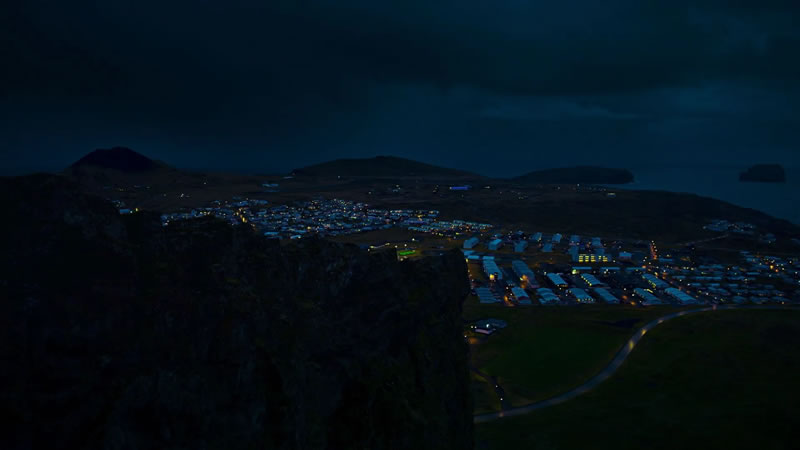
Cold Haven (2025)
Do you see AI and new technologies as a solution to some of the struggles of the industry?
Iceland has always been forward thinking when it comes to technology. We have a lot of companies that are developing software solutions. When it comes to AI within our industry, most production companies here are taking advantage of their software solutions for internal matters. But when it comes to visuals effects and other post production workflows, I do not see a big footprint right now. A lot of people are talking about it, but I think part of that plays into a lot of the post-production that’s taken outside of Iceland.
One of the things that excites me personally the most is the dubbing factor. I’m passionate about creating shows for my local audience, Icelandic shows in Icelandic, but that is an extremely difficult task. So I’m super excited to see if I can, in the near future, create relevant shows in Icelandic for my local audience, but have it dubbed with voice and lip-sync dubbing.
What shows is Glassriver working on at the moment?
Some of the projects that we are in, have been announced throughout the months and years. We are in post-production on two series: Avalanche and Elma. Avalanche is inspired by true events and the reality of the constant threat of the mountains here in Iceland. And Elma is based on a book series, made in partnership with Mediawan Rights in France.
For this fall, we are optimistic to be in production on a show called Manifesto, set in a world where the first terrorist attack would take place in Iceland. We are also working towards Masquerade, a show that we pitched in Series Mania last year and is being co-produced through the US. And then also the series Hot Stuff [a co-production with Romania’s Idea Film]: we have already shot the portion of the show set in Iceland throughout the last winter and now we are waiting for the optimal season in Tenerife to wrap up that shoot there.